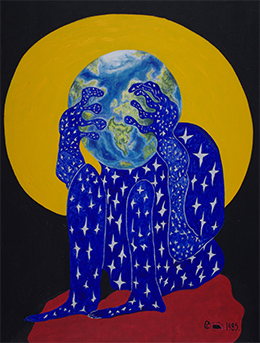
An amazing man Evgeny Berezikov
is 91 years old!
Reviews and comments from visitors to the website-gallery of the artist Evgeny Berezikov
- Dear Evgeny Efimovich, your paintings are an extraordinary world of the immortal Soul, stages of the Path to the Lord of worlds.
In them is revealed the essence of a subtle vision of life; beneath them is a precise, short title, like a postscript — but behind all this lies the height of Heaven, Truth — in short, a road without end.
It is impossible to simply "skim with your eyes" over these captured events; they stop the ordinary flow of thoughts and open up the subtle spiritual world: this is a Sermon.
Your unique paintings, books, lectures, prayers, and pilgrimage journeys across the globe — all of this allows for a deep understanding of the single meaning of the Holy Scriptures in all their diversity.
In the gallery of paintings, several are especially close to me — those that, in essence, explain my own life stages and the meaning of the events that occurred before I met you. These meanings illuminate the consciousness.
Thanks to this website, I saw for the first time the painting "Toward the Sun with Memory of the Earth" — it, like the paintings "Solar Man" and "Crown of Thorns," is the quintessence of human life! - It is wonderful that a virtual gallery of Evgeny Efimovich Berezikov's paintings has been created. Now many people have the opportunity to get acquainted with his work. The paintings are stunning, extraordinary, philosophical, and of incredible depth. The titles are very precise — they are like an extension and explanation of the painting itself. Some of the images in the paintings look at you, not just the other way around. There is something cosmic and intricate in them. They inspire reflection.
- The astonishing worlds of Evgeny Efimovich immerse one in the mysteries of the universe and introduce one to the hidden, concealed within everyday events. One must have such a gift — to perceive the infinite in the small! Behind these deep and accessible subjects, each viewer's own inner world unfolds. Entire epochs of this country passed during my youth in the Transcaucasus and my maturity in Russia. These vivid images are filled, for each viewer, with the meaning of the universe. Lyrical and finely vibrating, these paintings are a portal into the Cosmos.
- Evgeny Efimovich's paintings impressed me to the depths of my soul. And tears... and amazement... and joy... and peace... overtook me. The purity of colour, the waves — I will be thinking about and returning to your astonishing paintings-images for a long time to come.
I am familiar with some of the paintings; particularly close to me is "She Who Watches" — the salamander, which several years ago helped me. Her magical gaze enveloped me and held me for several days until I felt better.
I am grateful, deeply grateful, that it is possible to see your paintings — they are so full and multifaceted. They are like books: you open them, you see, you read, you reflect, and you understand for yourself a certain mystery — something that in everyday life you would neither encounter nor reflect upon, nor comprehend. - Divine paintings, angelic birds that saved my life when I was ill with Covid. I survived thanks to one of the birds — a purple bird that came to me in a dream and helped me. I have a calendar, and that painting is in it. I had severe lung damage. I am deeply grateful to you and to the Angels depicted in your painting. Any of your paintings can be viewed as a meditation. I am grateful to the Lord and to you for these wonderful paintings.
- I am full of admiration for the work of Evgeny Efimovich — an artist and a man with a capital M, who through his works expressed his love for his native land and for Uzbekistan.
- Dear friends! Evgeny Efimovich has posted the "Open Cosmos" Gallery on social media.
I would like to share with you my thoughts about Evgeny Efimovich as an artist and about his paintings. Most of us know him more as a traveler, writer, and enlightener, and less as an artist. For me, the concept of an artist was a traditional one — a person who embodies their ideas through brush, pencil, and so on. But in 2001, an exhibition of Evgeny Efimovich's works was organised in Tomsk and the city of Seversk, and it completely changed my perception of him as an artist. Out of more than a thousand paintings created by Evgeny Efimovich, no more than a hundred canvases were displayed at the exhibition — but they were the most expressive ones. Sergei Kunert lived in Tomsk for nearly two months, curating the exhibition — he was the attendant, the storyteller, the guide. I also tried to spend all my free time at the exhibition and help out. It was during that time that I felt, perceived, and delved into these paintings.
The exhibition was called "Cosmic Visions." And they truly are visions — there is no other word for them. Evgeny Efimovich himself said: "What I paint cannot even be called painting. It is more like cosmic visions. I have always painted only by inspiration — as if something came over me… I see the finished image, the colours, the movements immediately. I sketch it in about forty seconds, a minute and a half at most, and if the painting is large, I work on it in colour for two or three weeks."
All the paintings reflect life. There are self-portraits that reflect his state of being: "Harvesting the Fruits," "Self-Portrait Against the Sun," and others. There is a whole cycle about the Universe: "Triptych on Jesus Christ," "Crown of Thorns," "The Radiance of the Lord," "Thought on Eternity," "Triune Cosmos," "Passing By," "Flight in Parallel Worlds," and others. A cycle about political life: "Carelessness," portraits of Gorbachev and Andropov. About nature: "Farewell to Nature." Each of his paintings needs to be deciphered: it carries a specific meaning. Sometimes Evgeny Efimovich would receive a vision, make a sketch, but could not explain what it was. Then, sometime later, the events he had foreseen would occur.
It is very difficult to express all one's admiration in comments — one cannot write everything. I advise you to read Evgeny Efimovich's book "Studies on the Unknown," a story about the mysteries of transcendent worlds, Moscow, 2004. In this book, Evgeny Efimovich writes about the creation of more than 30 paintings — how he received them, through what visions, and at what time.
I want to say one thing: you and I are fortunate to have lived close to Evgeny Efimovich at the same time, to have attended his meetings, read his books, watched films about his travels, worked with the crystals he brought us. And now we have the opportunity to get to know his paintings. - I have looked at the artist's website and I am truly delighted! It is very aesthetic and well structured. It is a pleasure to read (and for me this is usually difficult in Russian) 👍☺
- The paintings are very cool! We are impressed 👍🏻👍🏻👍🏻👍🏻
- To paint such pictures, one must look at the world with different eyes and see what is not visible to others. I am a realist, but I too can see the deep philosophy in your paintings. Although I do not fully understand them. Well, to understand such paintings, one must study a great deal, and I believe that one day I will see the world through your eyes.
- I liked this artist's website. He is undoubtedly a genius who saw, many decades ago, what is relevant today!
Beautiful, modern, personal, and everything is well structured...
Well done 👍 congratulations!

© 2026 "Open Cosmos" Gallery