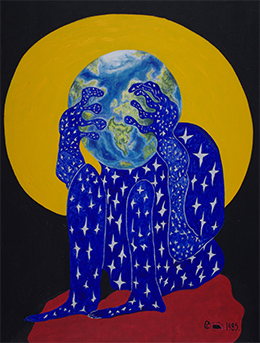
An amazing man Evgeny Berezikov
is 91 years old!
Canvas, acrylic. 80х60
Canvas, acrylic. 80х60
Painting and Graphics
The Cosmic Visions of Evgeny Berezikov
No less significant is the question of whether this child — this young man or woman — possessed the free will to choose their own path in life, and to what extent they were able to take full responsibility for their actions.
In the early 1940s, fate took his parents first to Ukraine, and then to Central Asia. The cause was war, evacuation, a bombed-out train, and the bitter experience of orphanhood: an orphanage, a juvenile correctional colony, vagrancy with a throng of homeless children, riding trains from station to station, from city to city. All of this entailed a brutal struggle for survival — heavy physical labor during adolescence and, over the course of a lifetime, an extraordinary diversity of professions.
Thus, over three years, from the ages of sixteen to nineteen, Evgeny, in search of a means to sustain himself in Central Asia, worked as a hired laborer, going door to door, digging vegetable gardens, molding bricks, building shelters, herding pigs, sheep, and cattle. He then entered industrial work, laboring as a loader at a textile factory in Tashkent.
He was drafted into the army and served in Germany as a tank driver-mechanic. After demobilization, as a civilian, he worked as an excavator operator. Later, on the recommendation of his work collective, he joined the internal affairs organs to fight crime — first as a cadet at a police academy, then as an operative, and eventually as the head of the criminal investigation department.
In his pursuit of knowledge, he graduated from the Academy of the Ministry of Internal Affairs, the Higher Party School under the Central Committee of the CPSU, and finally successfully defended his dissertation, earning the degree of Candidate of Juridical Sciences (Ph.D. in Law). For ten years, Berezikov served as the head of a city and then of an entire region.
He wrote poetry, short stories, and novels; directed feature films and documentaries (publishing a total of 34 books and completing nine films); and became a laureate of several song festivals in the Soviet Union.
And then, at the age of forty-five, as if all of this were not enough, painting struck Berezikov’s inquisitive nature with the force of a mighty hurricane. It utterly consumed his entire being, leaving nothing behind. In the artist’s own words, from that time onward he found himself perpetually in the grip of powerful, liminal visions, whose unusual energy would immediately translate into fantastical imagery and strikingly beautiful colours on paper, cardboard, and canvas. One painting, a hundred paintings, several hundred — each more extraordinary than the last.
To claim that Evgeny Berezikov was unprepared for this form of human creativity would be untrue. As a five-year-old boy on a forest path, he would watch in fascination as a ladybird fluttered from leaf to stem, as an ant stubbornly dragged its burden, as a capercaillie courted its mate in a forest clearing, as a hare raced across the frozen crust. Later, as a teenager among the sandy dunes of the Kyzylkum Desert — where fate had by then cast him — Evgeny would admire the acrobatics of a long-legged jerboa leaping from dune to dune, and would then race against the steppe wind himself, chasing after a tumbleweed bush.
Yet, as an analysis of the artist’s oeuvre reveals, those years were nurturing within him not merely the iconography of his future canvases — but, more crucially, an ever consolidating spirit of unprecedented strength, without whose fertilisation any painting would remain dead.
For many years preceding the creation of his symbolic works, Evgeny read voraciously — books on philosophy, history, astronomy, medicine, biology, the earthly, aquatic, and fiery elements, and the history of countries, peoples, and continents. Over those years, he absorbed a vast body of spiritual and mythological literature, amassed 700 albums of reproductions from all the world’s famous galleries, as well as albums devoted to the genius artists of every epoch and every nation.
And so, on this foundation, already in his mature years, an artist was born. The intensity of his creative work coincided with that period of his life when, having abandoned state service and politics, he — unexpectedly for everyone and even for himself — withdrew into hermitage and settled in the mountains of the Pamirs for three full years, living in solitude, in communion with nature, wild animals, and the spirit of the Cosmos.
According to the artist himself, his retreat into seclusion took place under the protection of the Lord God — the Creator of the Universe and of Man.
After returning from his hermitage to the Mainland on August 30, 1993, Evgeny devoted the following years to pilgrimage to the sacred and magical sites of the planet: Tibet, the Pamirs, the Himalayas, Mount Tabor, Sinai, the Gobi Desert, the Island of the Gods — Japan, the Arctic Circle, Antarctica, as well as to the pyramids of Egypt, the Hindu temples of India and Ceylon, the Lamaist temples of Tibet and Mongolia, the Church of the Holy Sepulchre in Jerusalem, the Church of the Nativity in Bethlehem, the druid temple at Stonehenge in England, the Mayan and Aztec temples in Mexico, and also to the holy places of Russia, Ukraine, Belarus, and the states of Central Asia.
*Everywhere, his journeys took place on the threshold of his exalted spirit entering other dimensions — an experience that gave rise to the symbolism of his images and found its reflection in his paintings. One can clearly trace those works that reflect creation, existence, nature, spirit, and the states of the human soul. The titles speak for themselves: Cosmogony, Creation of the World, Adam and Eve in Paradise, Mother of All Worlds, Eternity, The Birth of Christ, Footsteps of the Prophet, Keeper of Knowledge, The One Walking into Infinity, Boy Playing with Wolf Cubs, Flower of Mature Love, Mutant. *
Most of Evgeny's paintings are instantly recognisable, for they bear the imprint of a distinct cosmic energy — because every image born from beneath this artist's brush is a living spirit.
At first glance, the paintings may appear primitive in form — a style that in world art is classified as "primitivism" or "naïve art," a category that undoubtedly also applies to the work of E. Berezikov. Yet in terms of content, his paintings are the revelation of a universal thinker, for they are in some way akin to the works of Bosch, Leonardo da Vinci, Roerich, Picasso, Dalí, and Pirosmani. And it is precisely for this reason that the painterly oeuvre of this artist consistently arouses intense interest wherever it is shown.
In recent years, personal exhibitions of Evgeny Berezikov's paintings have taken place with great success in Russia and in several other countries around the world. They have been attended by nearly one hundred thousand people. In India alone, over the course of three months, several tens of thousands of visitors viewed the artist's works. Following the exhibition, at a reception in Delhi, the President of the Urdu Academy of Arts, Dr. Gopi Chang Narang, presented Evgeny Berezikov with the "Golden Necklace" award.
At present, exhibitions of works by the artist Evgeny Berezikov are being successfully held in cities across Russia, Ukraine, Belarus, and other CIS countries. And everyone who visits these exhibitions remains deeply moved, finding for themselves that unique quality present in the works on display. Some will be captivated by the imagery, others by the vivid colors, and still others by the spontaneity and almost childlike view of the surrounding world and Nature held by the Russian artist Evgeny Berezikov.
I wish success to all who visit them!
Olga Sviblova — Art Historian and Critic
Soviet Magazines
The cover of the magazine features the painting "The Great Bird" by the artist Evgeny Berezikov.


The cover of the magazine features a reproduction of the painting "Three Horses" by Evgeny Berezikov.


The color insert features reproductions of the paintings "A Midsummer Night's Dream" and "Child of the Star World."
Reproduction of a painting by Evgeny Berezikov
(Circulation of Murzilka magazine: 5,400,000 copies)


The cover of the magazine features a reproduction of the painting "Masks. Who Are You?" by Evgeny Berezikov.
On the inside back cover spread, a photograph of the artist is presented along with four of his paintings.


The cover of the magazine features a reproduction of the painting "Reflection on the Threshold of Life" by Evgeny Berezikov, while the back cover features a photograph of the artist and reproductions of two of his paintings.
A flight of thought and spirit, without limits
Symbols and Parables
Things are, as always, more than overflowing for the likes of us, so you take the slides more out of politeness than curiosity. And then — immediately, without preparation, without the obligatory ritual 'getting-to-know-you' conversations about art — you feel yourself drawn into a unique artistic world. Only later comes the turn to try and make sense of the expressive means that the artist employs — consciously or intuitively. But the first impression remains; it has become a lasting component of my relationship to the art of Evgeny Efimovich Berezikov — it is time, at last, to name the hero of these notes.
It must be said that this impression is shaped, in part, by certain features of Berezikov's appearance and fate. First of all, the contrast of his persona is striking — on the one hand, a highly organized, businesslike, assertive man; on the other, his art — extremely fragile, unprotected, openly emotional. No less surprising are certain turns in his biography.
The wartime hardships cast a six-year-old Siberian boy, a native of the Tomsk region, into Central Asia. Eventually settling in Tashkent, Berezikov — still a teenager — begins to work: as a lathe operator at an MTS (Machine and Tractor Station), a collective farmer, a worker at a spinning factory. Then, after serving in the Soviet Army, he works as an excavator operator. He joins the criminal investigation department in Tashkent. He attends the Higher School of the USSR Ministry of Internal Affairs. He works in Komsomol and Party capacities. He holds positions in the Party committees of Uzbekistan. And simultaneously — a passion for literary work, his first publications, and in 1982, the appearance of the first book of his novel "Red Bukhara", which was published in its entirety this year.
Literary interests prevailed — from 1985 onward, Berezikov became a professional writer. Such was his fate... But even that proved insufficient — in 1981, at the age of forty-five, Berezikov turned to the visual arts. Evidently, the need to express those potentials of spiritual life that could not be realized through literary work proved irresistible.
Artists who have not undergone professional training, yet who, by virtue of a certain scale of talent, transcend the bounds of amateurism, are usually classified as artistic primitives. The term is perhaps not a very felicitous one — it sounds too close to 'primitiveness,' which has an entirely different semantic charge. Nevertheless, the term is widely used, and this reflects a reality of the cultural life of our century, in which the line of artistic primitivism — despite an abundance of the most complex movements and trends — is clearly and, it seems, increasingly markedly traced.
Its landmarks are the work of such remarkable masters as A. Rousseau in France, our own N. Pirosmani, Grandma Moses in the United States — and many other names besides. These are artists who are absolutely different in their individuality, yet there is something common among them: an absence of preconceptions, and often an indifference toward artistic systems and movements; an organic naturalness and sincerity of expression. And, of course, talent — which allows them to achieve the highest artistry outside of a professional school.
What is the particular appeal of primitivism? In sincerity, of course; in natural gift, of course. But in something else as well. There are many talented amateurs who take up the brush in their spare time, but few achieve a sustained, astonishing success. Evidently, spontaneity and lack of preconception in self-expression — in the realization of one's own world — are not enough. What is also needed is a special richness of content in that world. What is needed is a startling independence of view, so characteristic of village philosophers. The combination of these qualities determines the wholeness, the scale, and the individuality of the world of a genuine primitive artist.
All of the above has been necessary only in order to approach a description of the type of artistic consciousness that the hero of these notes represents (he is, of course, not alone in this). To approach it — because his works, while possessing undoubted signs of artistic primitivism, nevertheless do not belong to it entirely. Artists of this type (they have not yet received a terminological 'fixation' in art criticism, but that is not so important), while preserving certain inner connections with folkloric, popular consciousness, and many typological features of naïve art, nevertheless differ sharply from earlier folk masters in a fundamentally different character of worldview.
They are by no means village philosophers in terms of culture, nor naïve dreamers and contemplators in terms of life stance. They are flesh of the flesh of modern life, with all its problems and stresses. They express — no matter how some of them may declare a desire for roots, for untaintedness and a primordial wholeness of worldview — the mosaic, contradictory, restless, and searching consciousness of modern urban humanity.
The concept of 'wholeness' — which, like a litmus test, determines belonging to genuine primitivism — does not apply here. Indeed, the type of relationship with the viewer is also different here: artistic primitivism, which returns us to fairy tale and the naturalness of folk wisdom, possesses the remarkable quality of recreation — the restoration of the viewer's vital and spiritual strength. Here, however, there is no refuge from painful, acute problems; the intensity and turmoil of the artist's emotions are transmitted to the viewer. Accordingly, alongside the traditional aspirations of primitivism, the content of the work of artists of this type becomes something very substantial — facets of modern human experience that have been 'underutilized' by both professional and naïve art.
I believe that Berezikov belongs precisely to this type of artist — moreover, his works help to form our understanding of this type. As already mentioned, he received no formal art education. Yet he has long been interested in art and has defined a circle of his own attachments — rather idiosyncratic and not entirely logical from the perspective of the traditional 'gentleman's set' of the contemporary aesthete. But these are his personal attachments: Dürer, Vrubel, Roerich.
A second layer of artistic reference points that have, one way or another, influenced the artist's language is the art of Central Asia — which he knows not second-hand but has studied seriously.
However, the artist's baggage consists not only, and not so much, of artistic reference points, but rather of life experience, a particular mode of perceiving the world, and spiritual depth. Here, probably, lie the differences between Berezikov's works and pure primitivism: a striving for immediacy and clarity is combined — conditioned by the personal experience of a man of his time — with deeply non-idyllic moods of anxiety, dissonances, and collisions.
One of Berezikov's early works, 'She Who Watches', becomes a symbol of such anxious moods. On a red carpet-like background, an unprecedented creature sprawls — a lizard-salamander? Some fantastic alien? Having merged with its environment, possessing the gift of mimicry (the creature's coloration imitates the color and texture of a water surface; its silhouette is whimsical and free, like the course of a riverbed), the creature does not slumber — it watches over human life. Benevolently? Probingly? Malignantly? The painting does not impose a solution or an answer; rather, with almost physical palpability, it imposes reflection...
If a pure primitivist most often creates a fairy tale or a legend, then Berezikov creates a bitter parable, at the heart of which lie the collisions of the present day. Take, for example, the work 'Another's Fruits': the surface of the earth is likened to an apple, the tree bears fruit abundantly, but the 'black man' ruthlessly breaks it, tearing fruits that are not his own, that he did not grow. And the red fruits in his hands turn black... The figural approach is extremely conventional, and the subject is as old as the world — yet the artist manages to convey a charge of bitterness, of anger, of real contradictions observed in life.
I would like to dwell longer on this real, life-conditioned basis of Berezikov's imagery. In the work 'Cotton,' the cotton flower appears not only as a perfect creation of nature and humanity but also as an animate being, capable not only of nourishing but also of destroying; its roots are likened to tentacles, in one of which lies an axe. 'Decoding' the image is not difficult, recalling recent events in the cotton-growing region. I believe that the realities of the artist's own fate — and not only his — are quite evident in even the most seemingly abstract parables. This is especially true of the cycle of works devoted, strange as it may seem, to eternal, seemingly eternal motifs. Foremost among them is the motif of choosing one's path — which, whatever one may say, never loses its relevance through repetition.
Several works treat the very process of choosing decisions — the significance and solemnity of that moment for a human life. 'Alone in the Whole World,' 'Those Standing Between the Columns' — it seems to me that these works are precisely devoted to the painful search for the one correct decision, chosen according to conscience.
It is curious to see what means Berezikov finds to show the duration, the extension of this process in time — a task difficult enough for any artist, let alone one without professional training. In the first work, this effect is achieved through the development of spatial planes that delay the movement of the eye; in the second, through rhythmic repetitions, an optical 'recounting' of columns that creates the impression of the rhythmic flow of time.
The choice can be honest, righteous, and then the trace of a person — as in the work 'The Footprint of the Righteous One' — is forever imprinted into the earth's bedrock, into human memory. But the choice can also be otherwise, and then the theme of cruelty, of betrayal of human and natural laws, emerges. 'Ready for Anything' is the result of precisely such a choice: a composition almost heraldic in its symmetry, as in an old miniature or on a playing card — the sinister attributes of murder, the garb of an executioner, whether medieval or buffoonish. I do not know whether the artist intended this association, but for me this image recalls Varlam, the character from T. Abuladze's film Repentance. There, too, villainy dresses itself in theatrical robes and uses medieval props.
Or take 'Look Back': a call to come to one's senses, to renounce an unrighteous choice, to cast one's gaze over the path already traveled on earth. The motif of choice is treated by the artist on multiple levels — here both the everyday choice and the global choice, one that operates with such concepts as humanity, history, and the planet.
It must be said that planetary thinking — in some, albeit initial, manifestations of it — is becoming a reality of modern human consciousness. Here — at the level of everyday awareness — there are both rudiments of a scientific worldview and traditional archetypes (are they not derived from science fiction?). And Berezikov perceives planetary thinking precisely in this way — in the rather contradictory connections between the global (it is no accident that he so often leaves his characters alone face to face with the cosmos and the main earthly elements) and the mundane, the philosophical and the everyday, the mythological and the frighteningly real.
And, of course, the persuasiveness of the artist's cosmic theme lies not in the symbols as such — which are, as a rule, quite typological — but in their painterly and plastic realization.
Using local colors, Berezikov achieves a high degree of emotional intensity. For example, in the work 'Post-Nuclear Winter,' the artificiality, unnaturalness, and deadness of the palette acquire a piercingly disturbing resonance.
Probably, the uniqueness of Berezikov's method lies precisely in this: the artist is able to reincarnate a surface-level, 'frontal' metaphor — a symbol worn thin by constant use, a commonplace truth, an archetype of mass consciousness — to defamiliarize it through his imagination, to explode it from within with unexpectedness and with a simplicity of plastic solution that might frighten a professional. Sometimes the 'trick' does not succeed — or rather, the artist fails to transcend the bounds of everyday consciousness... But more often than not... More often than not, the paradoxical nature of the solution breaks down stereotypes, and the most familiar of phrases — say, 'the fruit of knowledge' — acquires an unexpectedly precise visual expression.
Berezikov has now been working as a painter for seven years. He has managed to preserve the immediacy with which he resolves thematic tasks — tasks that naturally become more complex with the passage of time. His expressive means are also evolving: the palette, vibrating in characteristic tonalities, becomes more complex, more refined, more thoughtfully considered; the rhythmic structure becomes more confident, as does the artist's favored means of characterizing form — the arabesque.
This increasingly refined arabesque — which seems almost carved out of a mass of color, and in which memories of Central Asian miniature painting undoubtedly come to life — is combined with volumes that may be somewhat hesitantly and awkwardly shaped, but are very alive, natural, as if molded from some animate biomatter.
The works of E. Berezikov have already been exhibited in several solo exhibitions — in Tashkent, Moscow, and India. The world of Evgeny Berezikov, in its contradictory and conflict-ridden combination of the naïveté inherent to primitivism and, simultaneously, the troubling drama of modern, searching consciousness, cannot fail to meet with the understanding of viewers.
Alexander Borovsky, Ph.D. in Art History, Head of the Criticism Department at the State Russian Museum, St. Petersburg.
The article was published in the journal "Druzhba Narodov" (Friendship of Peoples), No. 12, 1988 (circulation: 790,000 copies).