Here you will learn about the artist's work during the years 1983–1986, while he was working in Samarkand

Visions from the Cosmos

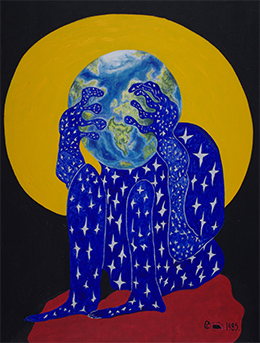
Painting by Evgeny Berezikov - Thought on Eternity. 1985
Thought on Eternity. 1985
Canvas, acrylic. 60х80
This is my most important painting, revealed to me in the city of Samarkand on August 23, 1984. On a Sunday afternoon, I came home from work at about 4:00 PM and lay down to rest on the sofa in the living room. Suddenly, an unknown force lifted me to my feet, then raised me up to the very ceiling — and there was already a starry sky. At the same time, a huge fiery Sun was shining through the window of the room, and an Angel of Heaven said: "You will receive the End of the World." I was frightened and fell back onto the sofa. Getting up, I sketched the study for the painting "Thought on Eternity" in one breath. Then, after some time, I painted it in colors. I did not want our earthly world to perish. I announced this event to humanity in the book "Studies on the Known," which was published in Moscow in 1991 in a print run of one hundred thousand copies and spread throughout the world. The symbolism of receiving the "End of the World" came to me on June 21, 2020, but the painting "Thought on Eternity" is still working properly.
A Unique Chapter in the Life and Art of Evgeny Berezikov

The Author's Reflections

Samarkand is a special planetary region, both in history and in the lives of many peoples from different countries around the world.
This is a special stage in my creative life. Naturally, after the Central Committee of the Republic of Uzbekistan sent me in 1983 to lead the Samarkand Region, I was, first and foremost, completely immersed in the administrative and economic affairs of this region with its multi-million population. For the first six months, I could not allow myself to think about anything other than solving my official duties. In the 14th–15th centuries, here in Samarkand, was the capital of Tamerlane's empire, and for many decades it was the center of political life, upon which the fate of dozens of states of that medieval period depended.
But the Cosmos, as we see, had its own plans. The best proof of this is a painting I saw on the Subtle Plane during the final days of my time in Shakhrisabz. Here it is — a work entitled "Blessing. The Keys to the Fortress."
Read more

Years passed, and the circumstances that characterised that global political order faded away. But the zone of phantoms — created by the battles and the colossal migration of human communities that existed in those times — remained unchanged. And these energy-phantoms made themselves known and manifested themselves in the society of the modern inhabitants of that once-mighty empire of Asian peoples.


And so, when I moved to these lands — which happened far from being in accordance with my own will... It was simply that the Subtle Plane, having transferred me from governing the city of Shakhrisabz, which was also the birthplace of Tamerlane, to the capital of his empire, thereby fulfilled the far-reaching plans of the Cosmos in the program of the Transfiguration and Ascension of planet Earth. I did not realise this immediately, but I did feel that my transition to governing the Samarkand Region was part of some profound program of Heaven.

For it was incredible that a young Russian man should take over the governance of a national region of Uzbekistan (though by that time I had already lived in Central Asia for more than 30 years and knew not only the Kazakh and Uzbek languages, but also the customs and rites of the local population).


And yet, the transfer from a small town to the largest region of Uzbekistan came as a great surprise — not only to me, but to most of the officials I had previously worked among. In effect, it was a major career advancement for me.


But the Cosmos, as we see, had its own plans. The best proof of this is the painting which I saw on the Subtle Plane in the last days of my stay in Shakhrisabz. Here is that painting. It is called "Blessing. The Keys to the Fortress."

Painting by Evgeny Berezikov - Blessing. The Keys to the Fortress. 1983

Blessing. The Keys to the Fortress. 1983

Cardboard, acrylic. 80×100

The painting is uncomplicated in its subject, but it concretely points to my transfer to Samarkand. Firstly, it is a stylised structure reminiscent of one of the palaces from the Timurid era, which still stand today on Registan Square in Samarkand. Secondly, on either side of the entrance to the Sanctuary stand two Hierarchs of the Cosmos with the texts of their declarations — one blesses with a cross, the other holds the key to the palace. And, what is significant for me, on the right sits the Keeper on a pole, and on the left — the bird of wisdom, Simurgh.
As for my entire period of stay in Samarkand, from 1983 to 1986, during those years I received, through visions from the Cosmos, a significant number of paintings and subjects on various themes — concerning both the spiritual development of people and the far-reaching plans of the Cosmos for planet Earth and humanity. These are the paintings I now present on the pages of this site, belonging to the Samarkand period.
Paintings Reproductions

Visions from the Cosmos – My Samarkand Period

Such were my feelings when the Cosmos first lifted me above the Earth. Fear, and curiosity, and the unknown…
Painting by Evgeny Berezikov - Climbed Up. 1984

Climbed Up. 1984

Cardboard, gouache. 50×70

Painting by Evgeny Berezikov - Hands of the Prophet. 1984

Hands of the Prophet. 1984

Cardboard, acrylic. 50×70

When humans climb the heavenly ladder toward God, for some of them the phantom of Earth (a Hierarch of the Cosmos) says: "You are still too small, unworthy and sinful" — and removes them from the Ascended path. This painting, "Ladder of the One Ascending to God," after it was completed, stood for many years in the hallway at the entrance to my apartment, and always reminded me — and everyone who entered — of the duty of Providence. Consider this deeply!
Painting by Evgeny Berezikov - Ladder of the One Ascending to God. 1984

Ladder of the One Ascending to God. 1984

Cardboard, acrylic. 75×100

Painting by Evgeny Berezikov - The Heavens Opened. 1985

The Heavens Opened. 1985

Cardboard, acrylic. 70×100

Symbolism. Such an action of the Heavens occurs only at the time of a change of civilization on planet Earth.
And so, by the will of God, a new generation of people has come to planet Earth. Thus it shall always be, as long as the world of the Cosmos and Nature exists.
Painting by Evgeny Berezikov - Adam and Eve in Paradise. 1984

Adam and Eve in Paradise. 1984

Cardboard, watercolor. 20×40

Painting by Evgeny Berezikov - Toward the Sun with Memory of the Earth. 1986

Toward the Sun with Memory of the Earth. 1986

Cardboard, acrylic. 35×50

This is the future of the enlightened Ascended man. Do not doubt it!
Have you noticed that the traveler has his friend the dog beside him, and — most importantly — on the right side is the plasma of Earth and Heaven? This means the path will be righteous. So it turned out for me. It will turn out for you too!
Painting by Evgeny Berezikov - Beyond the Seven Mountains. 1983

Beyond the Seven Mountains. 1983

Cardboard, acrylic. 50×70

Painting by Evgeny Berezikov - The Memory Bank of the Universe. 1986

The Memory Bank of the Universe. 1986

Canvas, acrylic. 50×70

That is precisely what the Bank of the Universe is — therefore it flies simultaneously in nine directions. May you also find these directions.
Despite all seas, oceans, and storms, every wise, kind, and skillful person with a pure heart and a bright soul will always be able to hold the two halves in balance.
Painting by Evgeny Berezikov - Holding the Two Halves. 1985

Holding the Two Halves. 1985

Cardboard, acrylic. 50×70

Painting by Evgeny Berezikov - Noon. 1985

Noon. 1985

Cardboard, acrylic. 50×70

Noon for our civilization was 40 years ago. Now we already stand on the threshold of the Apocalypse, and the first call from God to modern man is the coronavirus. Take heed!
Three horses – these are three periods of humanity's life: the white horse goes uncertainly – this is the reckless Middle Ages; the red, stormy (powerful, swift) horse – this is the symbol of our crazy, reckless, headlong period; and now we are inevitably awaiting the period of the black horse, walking with a sagging back toward the sunset. Save and protect!
Painting by Evgeny Berezikov - Three Horses. 1985

Three Horses. 1985

Canvas, acrylic. 80×100

Painting by Evgeny Berezikov - Jesus Christ. Creating the Cover. 1986

Jesus Christ. Creating the Cover. 1986

Cardboard, acrylic. 75×100

"By death trampling death," Christ creates for all enlightened people the Cover of Ascension and Immortality. Amen.
This is the future of the enlightened Ascended man. Do not doubt it!
Painting by Evgeny Berezikov - New Sprout. 1984

New Sprout. 1984

Cardboard, acrylic. 50×70

Painting by Evgeny Berezikov - Young Shoots. 1986

Young Shoots. 1986

Cardboard, acrylic. 50×70

In this was my joy — to see a young, pure person, as pure, and with love and tenderness, rising to life, just like young shoots in Nature.
The geniuses of all times and peoples never sink into oblivion — into the river of forgetfulness. They, regardless of the vicissitudes of fate, remain on the high bank of human history.
Painting by Evgeny Berezikov - Bust. Only for a Genius. 1985

Bust. Only for a Genius. 1985

Canvas, acrylic. 80×100

Painting by Evgeny Berezikov - Skull of the Sage. 1985

Skull of the Sage. 1985

Cardboard, acrylic. 50×70

While living in Samarkand and absorbing the medieval history of this region, I, in the image of a stargazer, brought forth for the modern world a symbiosis of the personalities of Tamerlane – the conqueror of 26 countries – and his grandson Ulugbek, who opened the starry sky to the scientific community of that time. A person can do anything, and a stargazer, to whose ranks I am also counted, even more so.
Painting by Evgeny Berezikov - Stargazer from Samarkand. 1983

Stargazer from Samarkand. 1983

Cardboard, acrylic. 50×70

Painting by Evgeny Berezikov - Abductor of Celestial Bodies. 1985

Abductor of Celestial Bodies. 1985

Cardboard, acrylic. 80×100

He is a modern-day American, Elon Musk, who wants to abduct the Moon and Mars. But no abductor of celestial bodies — neither earthly nor cosmic — has yet been able to stop the rising and setting of the Sun, or the rotation of the Moon as the companion of planet Earth, because everything in the Cosmos was created by the Lord God — including man himself.
Painting by Evgeny Berezikov - White Swan. 1985

White Swan. 1985

Cardboard, acrylic. 50×70

Painting by Evgeny Berezikov - Fighting Rooster. 1985

Fighting Rooster. 1985

Cardboard, acrylic. 80×100

This is you and me — we who destroy Nature, yet hope to forever gather its fruits. But this is not how it works in Nature. On lopped-off branches, fruits will never ripen again.
Painting by Evgeny Berezikov - Gathering the Last Fruits. 1985

Gathering the Last Fruits. 1985

Cardboard, acrylic. 80×100

Painting by Evgeny Berezikov - The One Who Nurtures Cotton. 1984

The One Who Nurtures Cotton. 1984

Cardboard, acrylic. 50×70

I lived in Uzbekistan for 60 years and saw how difficult the labour of the cotton grower is — both in cultivating and in harvesting the crop. This is the symbolism of my work.
This is the symbolism of harmony between Man and Nature (perhaps we will not lose this?!).
Painting by Evgeny Berezikov - Boy Playing with Wolf Cubs. 1984

Boy Playing with Wolf Cubs. 1984

Cardboard, acrylic. 55×75

Painting by Evgeny Berezikov - Boy with Dog. The Oneness. 1985

Boy with Dog. The Oneness. 1985

Canvas, acrylic. 80×100

The boy had a difficult childhood, as evidenced by the damaged finger (the little finger) on his right hand, as well as one of the flowers, the one depicted in a dark colour. But beside the boy is his faithful guardian — the dog — on whom he has placed his hand in hope. And throughout his life, this boy is protected by the Sun, which shines so generously upon him…
Of course, there is no absolute resemblance in this self-portrait — after all, I am not a professional artist. But I managed to convey the determination of character and the absolute involvement of this person in the boundless expanses and majestic laws of the great Cosmos.
Painting by Evgeny Berezikov - Self-Portrait. Gazing into the World (for the 50th Anniversary). 1985

Self-Portrait. Gazing into the World (for the 50th Anniversary). 1985

Cardboard, acrylic. 50×70

Painting by Evgeny Berezikov - The Sage and His Faithful Guardians. 1986

The Sage and His Faithful Guardians. 1986

Canvas, acrylic. 80×100

Nature never gives up a single sage. For the sage and Nature are always one whole.
Mature love is always deep, multifaceted, and eternal. Take a closer look. This flower is exactly where the symbolism of mature love is reflected in all its manifestations.
Painting by Evgeny Berezikov - Flower of Mature Love. 1983

Flower of Mature Love. 1983

Cardboard, acrylic. 50×70

Painting by Evgeny Berezikov - Flowers for the Beloved. 1983

Flowers for the Beloved. 1983

Cardboard, acrylic. 60×80

If you love someone selflessly and irrevocably, you will always be able to express this successfully in any of your actions. Just make the effort. They will surely see it.
It matters little what someone may point out to you. Think for yourself! For every person must choose their own path in life, alone!
Painting by Evgeny Berezikov - The Pointing Finger. 1986

The Pointing Finger. 1986

Cardboard, acrylic. 30×50

Painting by Evgeny Berezikov - Running Dogs. 1985

Running Dogs. 1985

Canvas, acrylic. 80×100

To reach the goal, the red dog runs a large circle, the white dog — a medium one, but the black dog runs the smallest and shortest of all, which is why it is not as worn out. Choose your own distance — if you can.
The bust is red, but the pedestal is black. An era. Reflect on this.
Painting by Evgeny Berezikov - Red Bust of Andropov. 1985

Red Bust of Andropov. 1985

Canvas, acrylic. 60×80

Painting by Evgeny Berezikov - Thorny Forest. Pass Through. 1986

Thorny Forest. Pass Through. 1986

Картон, акрил. 80х100

Thorny forest. Pass through! Such is my call — for I have already passed through it.
Although she is the daughter of the King of Beauty, outwardly she did not take after her father. Yet despite this, she holds a worthy place in human society, thanks to her assertive character and strong will to succeed in all her endeavours. She is self-sufficient.
Painting by Evgeny Berezikov - Daughter of the King of Beauty. 1985

Daughter of the King of Beauty. 1985

Cardboard, acrylic. 80×100

Painting by Evgeny Berezikov - Year of the Ram. 1985

Year of the Ram. 1985

Cardboard, acrylic. 80×100

Reflect: "Who is beckoning? And why are they beckoning?!"
Painting by Evgeny Berezikov - Beckoning. 1984

Beckoning. 1984

Cardboard, acrylic. 50×70

Painting by Evgeny Berezikov - The Hen or the Egg?! 1986

The Hen or the Egg?! 1986

Cardboard, graphics, acrylic. 80×100

There is no answer to this age-old question from any person in the world — except from John the Theologian: "In the beginning was the Word, and the Word was with God, and the Word was God." (Gospel of John, Chapter 1, Verse 1.)
Bird-humans (after their passing from life) give those who remain the opportunity to reflect on the righteousness of their further life path.
Painting by Evgeny Berezikov - Bird-Humans. Reminders. 1984

Bird-Humans. Reminders. 1984

Cardboard, acrylic. 70×100

Painting by Evgeny Berezikov - Scales, Weights of Heaven, and Deeds Done. 1986

Scales, Weights of Heaven, and Deeds Done. 1986

Cardboard, acrylic. 80×100

William Shakespeare: "We pray that God may not let us fall… There, in naked truth, our deeds lie without adornment."
Over the entire history of humanity, much knowledge has been accumulated by sages — but not all who come into this world feel the thirst to drink from the spring of knowledge.
Painting by Evgeny Berezikov - Keeper of Knowledge. 1985

Keeper of Knowledge. 1985

Cardboard, acrylic. 50×70

Painting by Evgeny Berezikov - Self-Portrait Against the Sun. 1986

Self-Portrait Against the Sun. 1986

Cardboard, acrylic. 60×80

The huge bright Sun depicted in the painting is evidence that the Cosmos and Nature are watching over this person. The ripe fruit in his hand is nothing less than a successfully completed labour. The colourful neckerchief on his chest is a sign of his level and degree of aspiration to art. And the olive branch is a clear token of society's recognition of the merits of the person portrayed.
Painting by Evgeny Berezikov - The One Who Kindles the Fire of Transfiguration. 1985

The One Who Kindles the Fire of Transfiguration. 1985

Cardboard, acrylic. 50×70

Painting by Evgeny Berezikov - Green Light to the Star World. 1986

Green Light to the Star World. 1986

Canvas, acrylic. 80×100

Painting by Evgeny Berezikov - Palm Branch of Peace. 1985

Palm Branch of Peace. 1985

Cardboard, acrylic. 35×50

Painting by Evgeny Berezikov - Those Who Have Attained Enlightenment. 1985

Those Who Have Attained Enlightenment. 1985

Cardboard, acrylic. 50×70

The huge bright Sun depicted in the painting is evidence that the Cosmos — and only those who have attained enlightenment — will ascend to the podium of Ascension.
Every intelligent person consciously chooses their own path in life. They also choose their spiritual beacon, and the Cosmos colours that path in the necessary energetic tones.
Painting by Evgeny Berezikov - Red Stone. 1984

Red Stone. 1984

Cardboard, acrylic. 50×70

Painting by Evgeny Berezikov - Eternity. 1985

Eternity. 1985

Cardboard, acrylic. 110×70

I have not placed this painting a second time by chance. For it is the main criterion of everything Divine — both on Earth and in the Cosmos: the Immortality of the intelligent child of God, regardless of the worlds in which he lives and will live. Eternity — in space and in time.
It is to us, people, that the Lord Creator, at the birth of every earthly child, has originally ordained spiritual peace. Take heed!
Painting by Evgeny Berezikov - All Is Calm in the World. 1984

All Is Calm in the World. 1984

Cardboard, acrylic. 50×70

Painting by Evgeny Berezikov - Trumpeting Ones. 1985

Trumpeting Ones. 1985

Canvas, acrylic. 80×100

It is the Cosmos that trumpets — both for an individual, announcing a change of stages in his destiny, and for all of humanity, announcing a Change of Times. For people have earned this themselves, committing abominations against each other and against living Nature. But for those who have been righteous in life, a gracious path is proclaimed.
He watches over the laws of Earth and Cosmos only when, in spirit, he attains enlightenment, and in mind — the Universal Information Field.
Painting by Evgeny Berezikov - The One Sitting Between Two Worlds. 1985

The One Sitting Between Two Worlds. 1985

Cardboard, acrylic. 80×100

Painting by Evgeny Berezikov - Only the Pure in Spirit Will Save the Earth. 1982

Only the Pure in Spirit Will Save the Earth. 1982

Cardboard, acrylic. 50×70

Painting by Evgeny Berezikov - Flight Through the Ages. 1985

Flight Through the Ages. 1985

Canvas, acrylic. 80×100

Painting by Evgeny Berezikov - The Young Man Who Has Known Love. 1985

The Young Man Who Has Known Love. 1985

Cardboard, acrylic. 50×70

Painting by Evgeny Berezikov - The Veil Covering a Maiden’s Face. 1984

The Veil Covering a Maiden’s Face. 1984

Cardboard, mixed media. 50×70

Painting by Evgeny Berezikov - Passions of the Secret of Love. 1985

Passions of the Secret of Love. 1985

Cardboard, acrylic. 50×70

The true nature of this little hen is hidden beneath the water. And although the rooster (the surrounding world) is making noise, the Cosmos knows the true state of the surrounding world. That is precisely why the Sun shines only halfway. Look for the further meaning of this parable-painting on the next page, in the painting about Gorbachev — the General Secretary of the CPSU.
Painting by Evgeny Berezikov - A Land Hen Under Water. 1984

A Land Hen Under Water. 1984

Cardboard, acrylic. 50×70

Painting by Evgeny Berezikov - Donkey by the Lake. 1986

Donkey by the Lake. 1986

Cardboard, acrylic. 36×48

In the figure of Mikhail Gorbachev, everything converged: the human and the Cosmic. Vanity, pettiness, small-mindedness, careerism, and the opportunity, afforded to him by the political system, through sycophancy, to slip unhindered to the very top of governing a vast state — the USSR. But the fact is that in the Cosmos too, all planetary circumstances had matured for the stage of a Change of Times for all of humanity. For this, it was necessary to transform the Soviet Union from a totalitarian state into the category of Holy Russia.
And the instrument for the collapse of the mighty USSR became precisely Mikhail Gorbachev. He handed over the Soviet state to the West lock, stock and barrel, and did it inconspicuously and swiftly, placing the peoples of the country on the touchstone of Perestroika. Overnight, the Soviet Union disappeared from the map of the world, replaced by an independent Russia, which, having cast off the yoke of godlessness (having built, over the course of 30 years, 22,000 Christian churches and 12,000 Muslim, Judaic, and Hindu temples), became the universal prayerful intercessor and saviour of peoples and states from aggressive enslavers of the world.
Hence, by the will of the Cosmos, from the very birth of Mikhail Gorbachev, a planetary seal was already marked on his brow, which is why he dismantled the USSR with such ease. And so you have the story of the fatal inevitability of his person.
And why do I speak with such certainty and authority about Mikhail Gorbachev? Because I, during the 1980s, as the head of the Regional Party Committee of the Samarkand Region of Uzbekistan, met repeatedly with the General Secretary of the CPSU and with other leaders of the Soviet Union, and with heads of state from abroad. And all that took place in the upper echelons of power in the USSR, I know not from hearsay, but from my own experience, as I held leadership positions in the Komsomol and the party nomenclature from 1965 to 1985.

Painting by Evgeny Berezikov - Gorbachev. Fatal Inevitability. 1987

Gorbachev. Fatal Inevitability. 1987

Canvas, acrylic. 50х70

Evgeny Berezikov and Egor Ligachev in Samarkand
Samarkand. The Second Secretary of the CPSU Central Committee, Yegor Kuzmich Ligachev, during his visit to the mausoleum of Tamerlane, is accompanied by the Second Secretary of the Samarkand Regional Party Committee, Evgeny Efimovich Berezikov (standing on the left behind E.K. Ligachev). June 1984.
Samarkand. The government delegation of Bulgaria, headed by the Chairman of the Council of Ministers, Grisha Filipov, and his wife, is welcomed by the Second Secretary of the Regional Party Committee, Evgeny Efimovich Berezikov, together with his wife, Ninella Kazimirovna. February 1984. (Evgeny Berezikov is standing fifth from the left.)
Самарканд
Anatoly Karpov and Evgeny Berezikov in Samarkand
Samarkand. A meeting of Evgeny Berezikov at the official residence with International Grandmaster Valery Salov and World Chess Champion Anatoly Karpov. 1985.
Samarkand. The People's Artist of the USSR, Lyudmila Zykina, who arrived on tour, is welcomed by the head of the Samarkand Region, Evgeny Berezikov. December 1984.
Lyudmila Zykina and Evgeny Berezikov. Samarkand
Concluding the narrative and the account of the creation of paintings during the Samarkand period, I wish to end this section with a reflection on the role that my epochal painting "Thought on Eternity" — which was painted precisely in Samarkand in 1984 — came to play in my subsequent creative destiny. As I wrote above, the painting "Thought on Eternity" was revealed to me by the Cosmos at the moment when Providence informed me that I would one day have to receive the End of the World.

The hologram of the painting "Thought on Eternity" functioned as a man-made pictorial collider.

Read more
In the years that followed, the painting "Thought on Eternity" always attracted great interest at all exhibitions of my works that I organized in the USSR, and after its dissolution, in Russia and other countries around the world. The hologram of the painting "Thought on Eternity" functioned as a man-made pictorial collider (I will leap ahead a few decades.

Thus, in 2011, under the auspices of the United Nations, a fateful document on the preservation of humanity on Earth was published, four hundred pages in length, and on the cover of this epochal document was my painting "Thought on Eternity." Naturally, thousands of artists would have dreamed of having their work featured on the cover of such an important UN document, which, after its release, was distributed for implementation in 220 countries around the world.

But, to support me during that difficult and stressful period of coming to terms with the "End of the World," the Subtle Plane arranged psychological support for me. Unexpectedly (as always in such cases), a correspondent arrived in the Samarkand Region from Moscow — from the digest journal Sputnik, published abroad on behalf of the Soviet Union, which was regularly distributed, once a month, in 120 countries around the world in 45 languages.

And so, this correspondent, sometime after several months had passed following my cosmic experiences, conducted an interview with me, and, literally in March of that same year, 1986, an article was published in that journal, spanning several pages, entitled "Evgeny Berezikov – A Happy Man," no more and no less.

Analyse the entire press of the Soviet Union over the past 70 years, and you will not find a single other article about a high-ranking leader in any field of activity, of whom it was declared to the whole world that he was a "Happy Man." But this impossibility, in my case, became possible because I myself am the impossible within the possible! For this is the work of the Cosmos...

Next, I am providing the text of this material, published in the journal Sputnik, No. 3, 1986.
Article in the monthly illustrated digest of Soviet printed publications Sputnik, No. 3, 1986.

Evgeny Berezikov – A Happy Man.

Berezikov's paintings are at once simple and complex. The artist does not impose his own interpretation on the viewer; rather, he invites them to penetrate the meaning of what is depicted for themselves.
"When I first saw Evgeny Berezikov's paintings, I was perplexed: figures of people — or not people at all, but strange, sad little creatures with aloof faces — frozen in whimsical poses, mysterious animals and birds in colourful plumage, unknown flowers and trees... And only after looking more closely did I begin to understand that behind the apparent irreality of what was depicted lay by no means fantastic images and thoughts. That these were paintings of reflection, paintings of revelation — by a man with a complex worldview, passionate and deeply engaged.
To interpret the meaning of a painting is always a thankless task: as they say, he who has eyes to see, let him see. This is easy to confirm.
Read more
From the canvas, the intelligent, weary eyes of "She Who Watches" look at you with a hint of irony. What is it — a mysterious unearthly creature, or simply the hurried flow of water in a river, reminding us of the fleetingness of life itself, or perhaps the restless movement of thought? The enigmatic gaze intrigues and stirs the imagination...

Berezikov's paintings are at once simple and complex. The artist does not impose his own interpretation on the viewer; rather, he invites them to penetrate the meaning of what is depicted for themselves. A kind of clue is provided by the captions beneath the paintings. The simple, laconic titles serve as a key to unlocking the artist's intention and understanding his remarkable images and symbols: "Solar Man," "To Drink the Cup," "Thought on Eternity," "Farewell to Nature," "Fruit of Knowledge"... Each painting represents the artist's candid "yes" and "no," his "for" and "against." A love for humanity and for all living things on earth — alongside an uncompromising rejection of vices such as greed, cruelty, and soullessness. Berezikov himself admits that he had long been searching for a way to express the feelings, emotions, and ideas that stirred his consciousness.

Specialists immediately took notice of his works, regarding them as a distinctive phenomenon. "He manages to depict with his brush such phenomena and ideas that had previously seemed impossible to convey in painting," said Uzbek academician of painting, the artist Ruzi Chariev, about Berezikov's work.
Evgeny Berezikov, Russian by nationality, lives in Uzbekistan, in one of the most picturesque and exotic cities — the ancient Samarkand.

He came to Central Asia as a six-year-old child: at the very beginning of the war, his family was evacuated to Kazakhstan. In 1942, notification came of his father's death, who had fallen in battle near Leningrad.

In that time of hardship for all Soviet people, children grew up early — their concerns were far from childish. Yesterday's boys had to think about their daily bread. At nine or ten years old, Zhenya Berezikov was already helping Kazakh shepherds drive flocks of sheep. Riding on a camel, he had to cover tens, even hundreds of kilometres from the collective farm to the pastures. This was how his working life began.

... Years passed, the war died down. Berezikov moved to Tashkent, the capital of Uzbekistan, and after completing his army service, came to work at a factory. He first worked as a stoker, then as an excavator operator. He was very young at the time, but his energetic, decisive character and his exactingness toward himself and others already singled him out as a leader. Even the older, experienced workers listened to his words.

Therefore, when at one of the Communist Party meetings it came time to elect a new secretary for the factory's party organisation, Evgeny Berezikov's candidacy aroused no doubts in anyone.
And a few years later, having graduated from the Higher Party School in Moscow, Berezikov became a professional party functionary.

Today Evgeny Berezikov is a well-known figure in the Republic of Uzbekistan. In recent years he has held a leadership post in the Samarkand Regional Party Committee. Before that, he was the First Secretary of the CPSU in the city of Shakhrisabz, the birthplace of Tamerlane.

Being by nature a restless person, he does not remain in his office for long. In the course of a single day, Berezikov can be found among the workers at a factory, in the office of a collective farm, and in a cotton field. He concerns himself with everything and has time for everything. How he manages this is a mystery to me. Knowing only approximately the daily volume of his work, one can only marvel at the inexhaustible energy and endurance of this man.

  • "What do you consider the most important thing in your work?" I ask Evgeny Efimovich.
  • "The matters I have to deal with day in and day out cannot be divided into main and secondary. Everything is important, and nothing can tolerate delay."
But perhaps the busiest time for us is the harvest season. It is well known that our republic is the main supplier of cotton. The importance of this raw material for the country's economy is enormous. That is why, for the party organs as well, the harvesting and delivery of cotton to the state is a matter of special importance.

But there are plenty of other concerns as well: both industrial and purely everyday ones. I think the main thing that attracts Berezikov in his intensely demanding work is the constant communication, the frequent meetings with people of the most diverse ages, professions, and ranks. In any audience he feels confident, converses easily, and quickly establishes rapport. Even on those rare days when he spends all his time at his desk, he is rarely alone there.

There is, in my view, a very capacious word — involvement. It is precisely this word that characterises this man most accurately. Involvement in everything that happens around him, a responsiveness to the grief and joy of others — this is a quality that is valuable in general. For a party leader, for a person whose decisions affect the fates of others, it is simply indispensable. I understood this when I came to know Berezikov more closely. I understood why for him there are no secondary concerns and cannot be.


  • "Evgeny Efimovich, but surely you do have some free hours, some time for yourself?"
  • "Of course," Berezikov smiles. "Not much, but I do. You see, I've even started painting. And I managed to write a novel over three holidays."
I am not surprised; I already know that he is referring to the novel Red Bukhara, published in Tashkent three years ago.

By that time Berezikov was already known as a publicist, the author of serious problem-oriented essays and articles devoted to the history and development of national culture, and to questions of the preservation of architectural and everyday monuments. Thanks to these publications, a broad readership both in the republic itself and far beyond its borders became acquainted with the distinctive art of Uzbek folk masters, ancient customs, rites, and legends. One of the essays in this series — "Three Peculiarities of Chiyalbazar" — readers of Sputnik could have encountered on the pages of our journal.

On Berezikov's initiative, a Public Council for Urban Planning was established in Samarkand. Its members include not only professional architects but also folk builders, who have long been renowned among local residents for their talented work.

The refined Eastern flavour of Samarkand obliges builders and designers to carefully preserve the appearance of the ancient city. Following the Council's recommendations, many modern buildings are complemented with traditional elements of national architecture, and unique ancient structures are being restored.

Recently Evgeny Berezikov celebrated his fiftieth birthday. Of course, this is not an age for drawing conclusions. And yet...

  • "Evgeny Efimovich, you cannot be called a favourite of fortune. Everything you have achieved in life did not fall into your hands by itself. Tell me, do you consider yourself a happy person?"
"I have never really thought about it. Remember, in one film a hero says: happiness is when you are understood. It sounds a little naive, but in essence it is true. In my work — working with people — this is the foundation of everything. When I write a journal article about the need to preserve one's culture, I count on understanding. And the paintings did not appear by chance either. I felt that in this concise form I could sometimes say even more than in a lengthy article or essay. And if they have touched or moved someone, then I truly feel myself a happy person".
After this publication and the reproductions of my paintings in the magazine Sputnik, the artists and writers of Samarkand began to ask me to organise a personal exhibition of my paintings and graphics. And I held such an exhibition in Samarkand in July 1985, displaying 52 of my most significant works. My paintings immediately aroused great interest and lively discussion.

To see these cosmic paintings, as the press had dubbed them, a large group of artists from Tashkent came specially to the exhibition in Samarkand.

Read more
It was headed by the Chairman of the Union of Artists of Uzbekistan, Bahadyr Jalolov. He was so admired by my works that he even asked for one of the paintings, "Black Apples" (this painting was the fruit of reflection in the struggle for the preservation of Nature), in order to display it in his studio and exhibit it to students of the Institute of Culture. I, of course, granted his request, for only in this way could the hologram of the painting work among people.

The same exhibition, but this time organised in Tashkent in March 1987, was visited by a guest from India — the President of the Urdu Academy of Arts, Gopi Chang Narang — and he was literally stunned by what he saw. In the guest book he left the following entry: "Beyond all expectations!!! This is incomprehensible!!! The stamp of uniqueness." And following our meeting, Dr. Gopi Chang Narang suggested that I hold an exhibition of my paintings in India. Naturally, this was a new stage in my work as a painter.

World Chess Champion Anatoly Karpov expressed himself very distinctively about my paintings. While in Samarkand in 1985, he visited the exhibition and wished to meet me, and afterward presented me with his book "On Chess Mastery," in which he left the following inscription: "Sincerely amazed by the versatility of Evgeny Berezikov's talent." In giving this assessment of the paintings that had astonished him with their cosmic philosophy, Anatoly Karpov also added his opinion of my songs, which he had heard on the plane while flying from Moscow to Tashkent, and then from Tashkent to Samarkand. At that time, on board the aircraft of Uzbek Airlines, in order to maintain the national character of the southern republic, my songs were constantly played: "Shakhrisabz," "The Golden Domes of Samarkand," and "The Musical Teahouse." And Anatoly Karpov said to me at our meeting: "Evgeny Efimovich, I heard the song 'Shakhrisabz' several times on the radio in Moscow and thought it was a folk song about a mythical city in the East. But when I learned at your exhibition that you are not only a regional leader and an artist, but also the author of such unique songs, I had no other words left, and I wrote: 'Sincerely amazed by the versatility of talent...'"

In Samarkand in 1985, the journey of my paintings to the people had only just begun. This was followed by exhibitions of holographic canvases, painted by me from visions from the Cosmos, in Tashkent in 1987, in Moscow in 2008, in Delhi – India, and in the Russian cities of Yekaterinburg, Tyumen, Tomsk, Seversk, and Ufa. And everywhere, people, sensing the unusual energy of the paintings from the Cosmos, literally came in their thousands to the exhibitions of Berezikov's painting.


Картина Евгения Березикова Цветы XXI веку. 1985 - 2001
Flowers for the 21-st Century. 1985-2001
Cardboard, acrylic. 50х70
"Flowers for the 21st Century" is one of my last paintings completed in Samarkand. It is dedicated to the beauty in nature — flowers. These flowers are a miracle in colours, revealed to man by the surrounding world in unusual forms. This is exactly what I wanted to convey in the painting. Now, while selecting this painting for publication in the album, I suddenly noticed that my flowers, dedicated to the 21st century, are depicted in the painting with their inflorescences turned inward, while outward they face thorny branches. And it turns out that the flowers in the painting, painted in the 20th century, in 1985, were rainbow-coloured, while in the 21st century they are forced to defend themselves from human society. And indeed, in our earthly life in this new century, so it has turned out — and the painting "Flowers for the 21st Century," with its piercing thorns, is nothing other than a wreath of the spikes of the coronavirus.