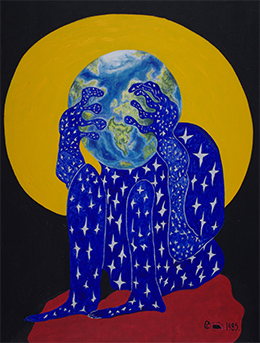
An amazing man Evgeny Berezikov
is 91 years old!
Here you will learn about the artist's work during the years 1980–1983,
while he was working in Shakhrisabz
Entering the Unknown


Cardboard, tempera. 80×100
Author's Introduction
Michelangelo
Naturally, from the very first days of taking up the administration of cities — having behind me many years of experience in the construction of a large chemical plant in the Kashkadarya region of Uzbekistan — and upon entering the governance of the city, I began to actively immerse myself in the processes of production, public order, and construction, which, like a living organism, never cease to develop in any city, in any inhabited place in any state of the world.
About a month or a month and a half later, the director of the distillery asked to meet with me to present the sketches for the tasting hall design. I scheduled him for the following Monday, as this conversation of ours took place at the beginning of my workday on a Sunday (for most diligent heads of cities, regions, and states, there are practically no days off as such). But in the time between Sunday and Monday, an extraordinary incident occurred — one that is directly relevant to this album of my graphic and painted works being published.
In the early days in the city of Shakhrisabz — which lies cozily in the foothills of the Hissar Range, between the Tien Shan and the Pamirs — I took for myself, on the very outskirts of the city, near the green canyon that stretches deep into the mountain massif, a temporary dwelling: a room that had once been an abandoned collective farm administration office, whose lands had not long before been ceded to the city. And so I lived there in seclusion, yet not far from the city quarters.
And so it was that before that very Monday — when I had scheduled my meeting with the distillery director — on a Sunday night, I awoke to incredibly powerful claps of thunder and most intense flashes of lightning, which created a true apocalypse of light in my vast room. After having woken up from the most powerful thunderclaps and sat up, swinging my legs off the bed, I immediately saw how the enormous room, lit by the lightning flashes, suddenly turned into a pitch-black den of iniquity.
By a tall, silvered, light-bearing wall stood a small group of tall, almost three-meter-tall, square-shaped people. But they were not statues, not mannequins — they were living beings. They moved, actively waving their arms, and with their voices beckoned me toward them. And, strangely enough, I was not afraid of all this apocalyptic display of light; instead, I stood up and walked toward their mysterious threshold.
For there, before these enigmatic people, stood a kind of special partition — made of a volumetric wall of mother-of-pearl-colored Chronomist (Time Mist), which divided our three-dimensional world from that transcendent cosmic realm beyond. And without a second thought, I stepped across it…
In the morning, upon waking from sleep, I suddenly felt — for some reason — from that incredible cosmogonic spectacle I had witnessed, a great and inexpressible joy that filled my entire being, from my sensory consciousness down to my trembling, joyful soulfulness. And I understood that this transcendent feeling was instilled in me by the real reality of that exalted world — which I had beheld here, on Earth.
And as a result, I felt an incredible need to immediately capture, to sketch the nocturnal miracle I had witnessed. And although I had never drawn anything in my life, except as a child — a stick, another stick, a little cucumber, and there's your little man! — when I took a large sheet of Whatman paper lying on the table (on which I made sketches and drawings of roads being laid in new construction sites), I immediately, on that large sheet of Whatman paper, with incredible speed, drew (captured) the nocturnal vision. I drew the lightning flashes and the mysterious giant people emerging from that light-bearing den of iniquity, and I also captured myself standing before them. And for some reason I called this sketch 'Me and Them.'
And while I was having breakfast and getting ready to drive into the city for work, I kept returning, again and again, as if mesmerized, to look at my sketch of such unusual nocturnal visions. And when I drove off to work, I could not leave that sheet of Whatman paper with its sketches behind in the apartment. For some reason I very much wanted these mysterious people — depicted on the Whatman paper — to be with me constantly. For some unknown attraction emanated from them, and I felt myself absolutely happy within it.
So then, when from the reception area, via the intercom, the secretary announced that the director of the distillery had arrived with the sketches for the tasting hall design, I allowed her to invite him into the office. But to my surprise, two young men entered along with the distillery director. And as it turned out, they were artists from Georgia, who had brought to show me the variants of their proposals for the tasting hall design. I made my observations and gave my consent to begin the work.
And then, when the invitees were about to leave, one of the artists, addressing me, suddenly said: 'Who made these wonderful sketches?' And he pointed to my sheet of Whatman paper with its nocturnal sketches, which lay on my desk, in front of the telephone. Somewhat surprised by such attention to my drawings, I immediately replied: 'Don't pay attention to my clumsy scribbles.'
This is just me, this morning, for the first time in my life, trying to capture in memory a single moment I witnessed." To which the young artist from Georgia, to my surprise, said: "You should know that not even the most famous artists could draw something so artfully and mysteriously. You have something special".
And with that, my business meeting with the distillery director and the Georgian artists came to an end — but the conclusion of one of the young men greatly surprised me.
Another month passed. This time, the director of the distillery invited me to see how he had finished decorating the tasting hall. I found the time and drove to the plant. The decoration done by the Georgian artists pleased me. It was colorful and vibrant. But as I entered the hall where the work had been carried out, I saw that brushes were scattered across a large table, and in several small bowls there were remnants of diluted paints.
Just before leaving the hall, I approached this table and, addressing the young artists, said: 'May I try to draw something? And would you show me how to prepare the paints?'
Such a question on my part was quite natural, for in truth I had never in my life held paintbrushes in my hands nor diluted paints, and here I saw everything ready. Moreover, the young artists, fulfilling my request, prepared everything instantly. And I immediately, taking a brush, and as best I could, on a sheet of Whatman paper measuring 40×60 cm, made a drawing of a man who had a black heart, and whose right arm, up to the elbow, was also painted over with black paint. In this way, on the spot, I captured a repulsive man with a black nature.
Seeing this sketch, the young artists from Georgia were sincerely astonished and asked me to give this drawing to them as a gift. After that day, I, as if possessed, began incessantly to cover sheets of Whatman paper with drawings, depicting on them the various sensory states that constantly visited me. And there were very many of them in the surrounding life. And most of them demanded immediate self-expression.
In the early days, I acquired for myself colored pencils, watercolor and gouache paints, as well as brushes for drawing.
And then, a little later, when this process of painting became increasingly serious, I acquired, in the early stages, special cardboard for drawing, as well as a primed roll of canvas for painting. And a little later, I acquired acrylic and oil paints with thinner.
Given this unexpected, overwhelming need for painterly self-expression, I had, on the one hand, to do it exclusively in my free moments — of which, as the head of a city, I had practically very few — and, on the other hand, to do everything so that not a single soul would know about my new passion.
It was enough that everyone knew that I wrote poetry and short stories and was a member of the Union of Writers of the USSR. And especially after a song was written to my words, 'Shakhrisabz,' which made this city famous, becoming a hit throughout the Soviet Union — after this song became the winner of the 'Song of the Year' competition at Ostankino.
Then, to my poems, several songs were recorded in millions of copies on records at the Aprelevka Record Plant in Moscow, and an album titled 'The Camel's Beard' was even released on a silver disc in the United States, which spread throughout the world.
In addition, based on my story 'Do Not Fear the Cobra,' a two-part feature film, 'The Long Echo in the Mountains,' was made at the Uzbekfilm studio. In the following years, from my pen came two short novels, three novels, biographies of the saints of Islam, as well as more than 30 books about travels across countries and continents, with a total circulation exceeding one and a half million copies.
But if we are to seriously address the essence of my work as a painter, against the backdrop and example of the artists who have appeared to the world throughout all the times of the existence of this form of art, then an unexpected paradox emerges...
It is well known how an artist who leaves a noticeable mark with his work in the historical space of painting comes into the world. Firstly, for the majority, the inclination toward drawing and the art of painting manifests itself often from early childhood. Secondly, those favored by Melpomene invariably begin to learn the skills of proper painting in special schools or enroll in the studios of venerable artists. Thirdly, those who display truly outstanding abilities in painting are typically sent for many years of study at academies of painting or other educational institutions of artistic creativity.
And I can note that nothing of the sort ever happened to me in my life along that well-worn path. And yet, suddenly — such a primitive starting point with the night sketches, and at first glance, such a banal story of how I began my simple painting, glimpsed in the flash of lightning, and how, from the fleeting opinion of those young visiting Georgian artists, I already began in earnest my great, unknown journey as a painter.
And moreover — a man already over forty, overburdened as an official, occupied with administrative and production matters, carrying on his shoulders the 'headache' for an entire city of many thousands. And yet this same man now presents for public viewing his incredible artistic works, which, at first glance, might not even seem to be such according to the world's generally accepted classification…
And here an unexpected turn awaits us — this is not how people act, but rather the Cosmos, the Higher Realm, and the Subtle Plane. They take a person and introduce him into their transcendent cosmic program.
Just look: I am the head of a city, with a brilliant career ahead of me. Indeed, in the future I became the head of the Samarkand Region — with a population of more than three million people, and not just any ordinary region, but the former capital of Tamerlane's empire. What more could one want? It is quite possible that a career lay ahead not only at the republican level but also at the all-Union level. But no. It turned out quite differently.
First, the Cosmos sent me for three years, from 1991 to 1993, into the hermitage of the Pamir Mountains, and then on a journey to forty countries and six continents of the Earth — including the South and North Poles of the planet. And not simply a journey, but one of prayers and sermons to different peoples and people professing different religions. And over a twenty-year period, more than one and a half million enlightened followers followed me in this extraordinary spiritual endeavor, both in Russia and in other countries of the world.
But you might ask: 'What does the Cosmos have to do with painting, exhibitions, and sermons?' And here is the answer: everything that happens in the world of people is first modeled in Heaven and concentrated in the annals of the Universal Information Field, from where it sends commands for action to the planet Earth, to society, and to people. And sometimes these commands are encoded in the form of images and symbols in paintings, as well as in the words of preachers and in the streams of music of genius composers. For a painting — if it is transmitted from the Cosmos — is already a message-hologram, a command for action...
If a painting revealed to a person is reproduced by them, then the hologram is launched. But when the action itself will occur depends on the politicians — some of whom are also given to society from the Cosmos.
And so, being an ordinary official, after I had received these not-quite-ordinary drawings and, accordingly, was included by Heaven into this special cosmic program, soon afterward — on the night of November 7–8, 1981 — an Angel of Heaven said to me: 'There will be no CPSU, there will be no USSR.' And I immediately painted a picture of a man standing at full height, symbolizing the Soviet Union, while this man's head had already flown from his shoulders, and he had not even raised his hands to save himself.
And although the collapse of the Soviet Union as a state (following the agreement signed by the putschists in Belovezhskaya Pushcha in December 1991) occurred only ten years after the message of the Angel of Heaven, the hologram of this event entered the social world through my painting about the collapse of the USSR, which I called 'Carelessness.' In the years since 1981, it has been published in a number of media outlets in circulations exceeding one hundred thousand copies, and thus it actively became part of this cosmic program.
Then, after my trip to India in 1981, in June 1982, I completed the painting 'She Who Watches'
In this painting, I depicted a fiery salamander that appeared to me in an old ruined Hindu temple. It, too, was a messenger of the Cosmos and symbolized the impending ascension of a new plasma race of people on planet Earth. The reproduction of the painting 'She Who Watches' was published in a print run of two hundred thousand copies in the USSR and in the new Russia, and was also published in the digest journal 'Sputnik' No. 3 in 1986, which was translated by APN (the USSR's 'Novosti' Press Agency) into 45 languages and distributed in 120 countries.
In accordance with the hologram of the Cosmos, the cover headline of the 'Sputnik' journal read: 'Caring for the Man of the 21st Century.' On the pages of the same issue, an article was also published: 'Evgeny Berezikov – A Happy Man.'
And in 1982, near the city of Shakhrisabz, as I was approaching the construction site of a reservoir in the mountain foothills, against the backdrop of a green hill, I saw with my own eyes the image of a standing giant human figure, forty meters tall. With one hand, he held a lightning bolt in the heavens; with the other, the growing shaft of the Earth. I understood that this cosmic image revealed to me symbolized the eternity of human existence on Earth.
Returning to the city, I sketched on canvas a study of the painting of this cosmic man I had seen, and called the painting 'Son of Earth and Sky.' Recognizing the importance of the subject of the painting, I decided to paint it in oils. I worked on this painting for exactly two years.
Thus, while being a successful official in society, occupied with economic and administrative affairs, I constantly experienced thousands of situations — everyday, natural, cosmic — and, at the same time, continually filtered through myself the ethical, psychological, and moral actions of people. And all this diversity of feelings and impressions, through my contemplative imagination, yearned not only to find expression in short stories and novels, but, in recent times, more and more often it was realized as sketches, as paintings on canvas, on board, or on sheets of Whatman paper. And all this diversity of feelings and images wanted to live its own life.
And this unusual need for self-expression, for the realization of feelings and views of the surrounding world, sometimes drove me to the point of madness — for sometimes in a single day I would produce (render) in images up to nine or ten subjects. And imagine — this unusual creation, or rather, this compulsive state, continued, lived inside me, and kept me in tension for many decades. And the Cosmos was indispensable in this, for without the corresponding energy, not a single sketch, not a single painting could have come into being. And yet there were thousands of them!
And at the same time, due to my administrative position, I had to play the silent game, pretending that everything was proceeding as usual. In doing so, I wanted neither praise nor admiration from people; on the contrary, I wanted to ask their forgiveness — and moreover, in most cases, for their own imperfection. This is roughly the same thing that the brilliant Nikolai Vasilyevich Gogol did with his close circle.
For he, as a protest against the imperfection of people, declared a forty-day fast, during which he died not only from the emaciation of his flesh, but also from the exhaustion of his mind, suffering compassion for people. And on this theme, I too painted a painting dedicated to Gogol — but in essence, simultaneously to myself — calling this painting: 'To Gogol — O Lord, Who Are We!?'
Yes, truly, all of us, people, have a need to ask ourselves: 'O Lord, who are we?!'
And perhaps you, too, will find the answer to your own long-suffering question in my paintings!
I would like to believe so!
Evgeny Berezikov
Entering the Unknown – My Shakhrisabz Period

Cardboard, tempera. 30х50
A reproduction of this painting was published in numerous media outlets, was issued as a postcard in a print run of twenty thousand copies, and also graced the pages of the digest journal Sputnik, which was distributed by APN (the USSR's Novosti Press Agency) in 120 countries around the world in 45 languages.
Then, for the second time, 'She Who Watches' – the Fire Salamander – appeared to me again in the flesh, in the Southern Urals, in June 2015, at the threshold of our generation's transition into other Ascended worlds.

Departing. 1984
Cardboard, acrylic. 50×70

Solar Man. 1981
Cardboard, tempera. 75×105

Beyond the Seven Hills. Choose. 1988
Cardboard, tempera. 80×100
And so it came to pass, exactly ten years later, after the putschists signed the agreement on the dissolution of the Soviet Union in Belovezhskaya Pushcha. And the people of the USSR remained silent — they did not even attempt to save their union state.

Carelessness. 1981
Cardboard, tempera. 75×105

Battle of the Red and Black Bulls. 1985
Cardboard, acrylic. 80×100

Fortune. 1985
Cardboard, acrylic. 80×100

The Great Bird. 1982
Cardboard, tempera. 80×100

Bearer of the Flower of Life. 1980
Cardboard, tempera. 75×100

In Harmony with Nature. 1982
Cardboard, tempera. 75×100

Fruit Seller. 1982
Cardboard, acrylic. 80×100

The Great Flower. 1982
Cardboard, acrylic. 80×100

Trumpeting. 1983
Cardboard, acrylic. 50×70

All Is Calm in the World. 1983
Cardboard, tempera. 70×100

Son of Earth and Sky. 1982–1984
Canvas, oil. 100×150

Khozrat-Khizir. The Prophet. 1982
Cardboard, acrylic. 80×100

Fruit of Knowledge. 1982
Cardboard, tempera. 60×80

Guardian. 1980
Cardboard, acrylic. 80×100

Buddha Sitting Under the Bodhi Tree. 1982
Cardboard, tempera. 80×100

To Drink the Cup. 1982
Cardboard, acrylic. 70×100

Prophet Creating the Cover. 1982
Cardboard, tempera. 70×100

Lighting the Candle. 1982
Cardboard, tempera. 80×100

Praying for the Fallen. 1983
Cardboard, tempera. 70×100

To Brezhnev. The Head of an Argali on a Golden Pedestal. 1982
Cardboard, tempera. 70×100

Rider on a Horse with a White Flag. 1983
Cardboard, tempera. 50×70

The Enlightened Thinker. 1982
Cardboard, tempera. 75×100

Ready to Fulfill His Duty. 1983
Cardboard, tempera. 75×100

Love. Two: He and She as One. 1982
Cardboard, watercolor. 70×100

Flying on a Hang Glider. 1982
Cardboard, watercolor. 70×100

Allegory of the Universe. 1983
Cardboard, acrylic. 70×100

The Outcome. 1981
Cardboard, tempera. 70×100

Starfall. 1981
Cardboard, acrylic. 50×70

Star Mother. 1983
Cardboard, acrylic. 80×100

Pecking. 1982
Cardboard, acrylic. 50×70

Tears. 1983
Cardboard, acrylic. 60×80

Tracks on the Rock. 1983
Cardboard, tempera. 50×70

Apple Stealer. 1983
Cardboard, gouache. 50×70

Drummer. 1982
Cardboard, tempera. 80×100

Banya. Three Beauties. 1981
Cardboard, tempera. 80×100

Falling Leaves. 1983
Cardboard, acrylic. 50×70
Autumn colours — like human destinies,
Now yellow-green, now blue,
They fell from the branches, like weary people,
And lay down on the ground, like fallen leaves…

Man with a Flag. 1981
Cardboard, tempera. 50×70

Bearer of Fruits. 1983
Cardboard, watercolor. 50×70

Remembrance. 1983
Cardboard, acrylic. 50×70

Bearer of the White Fire. 1984
Cardboard, acrylic. 50×70

The One Walking to the Summit. 1983
Cardboard, acrylic. 50×70

Apocalypse. The Closing of the Underworld. 1982
Cardboard, acrylic. 75×105

She Who Comes from the Sun. 1981
Cardboard, acrylic. 50×70

Seated Prophets. 1982
Cardboard, acrylic. 70×100

Fountaining Brain. 1982
Cardboard, acrylic. 35×50

Path of the Righteous One. 1983
Cardboard, acrylic. 50×70

Self-Portrait. Harvesting the Fruits. 1983
Cardboard, acrylic. 50×70

Those Who Support Christ. 1984
Cardboard, acrylic. 50×70

The People. 1983
Cardboard, acrylic. 55×100